V5C logbook checks before you buy
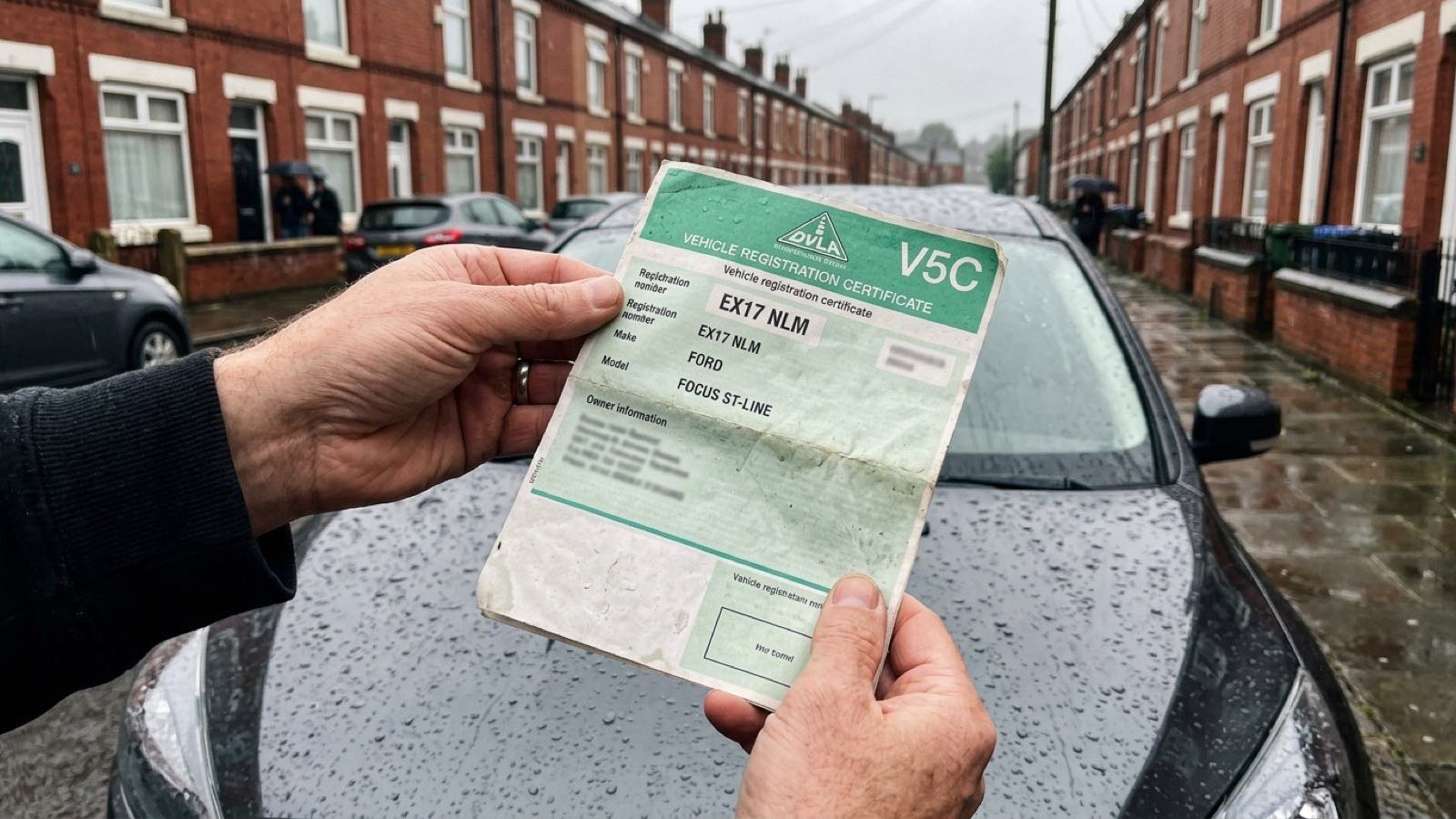
A V5C shows who DVLA has recorded as a car's registered keeper, not who legally owns it, a distinction DVLA prints on the certificate itself. Before you pay, matching the V5C's details against DVLA's own free record, and the physical document against the car in front of you at the viewing, is part of what GOV.UK itself recommends checking before buying a used vehicle. A car with no V5C at all is one GOV.UK advises against buying in the first place.
A V5C shows who DVLA has recorded as a car's registered keeper, not who legally owns it, a distinction DVLA prints on the certificate itself. Before you pay, matching the V5C's details against DVLA's own free record, and the physical document against the car in front of you at the viewing, is part of what GOV.UK itself recommends checking before buying a used vehicle. A car with no V5C at all is one GOV.UK advises against buying in the first place.
Applies to: the United Kingdom (DVLA vehicle registration certificate) Source: GOV.UK (DVLA) Checked: August 2026 Main exception: the V5C is not proof of ownership, only of who's registered as keeper; if the car has outstanding finance, the finance company can hold legal ownership regardless of whose name is on the certificate.
1. What a V5C actually proves, and what it doesn't
The V5C, still widely called the log book, is the certificate DVLA issues to a vehicle's registered keeper. DVLA prints a statement on the certificate itself making clear it isn't proof of ownership: the keeper and the legal owner aren't always the same person, most obviously when a car is on finance and the lender holds title until it's paid off. What the V5C reliably shows is who DVLA currently has on record for that registration, which is exactly why matching it against DVLA's own data, rather than trusting the paper alone, is the useful check.
2. DVLA's own buying checklist, in two stages
GOV.UK splits the whole used-car buying process into two distinct moments. Before you view the car: verify the seller's details match DVLA's records, check the MOT history, and review any safety recalls, all checks you can run from home with just the registration number. At the viewing itself: check the V5C document for DVLA's watermark and a serial number outside the two ranges known to have been stolen blank, since that's what actually confirms the log book isn't for a stolen vehicle, and you need the physical document in hand for that, not just the registration. Only once you're satisfied on both fronts do the remaining steps follow: register the vehicle and get a log book if you need one, arrange insurance, and tax it before you drive it.
3. Matching the V5C to DVLA's free record
DVLA's vehicle enquiry service, free and needing only the registration number, shows the current tax status and expiry, SORN status, MOT expiry date, the date the vehicle was first registered, engine size, fuel type, CO2 and emissions data, and the date the last V5C was issued. It deliberately stops short of the registered keeper's name and address, colour, and VIN, none of those three come back from this lookup: "you must write to DVLA to request information about the current or previous registered keeper of a vehicle," and DVLA only releases colour the same way, in writing. So the free check confirms the vehicle itself matches DVLA's record on make, model, engine size, fuel type, and first registration date; colour and VIN are things to match against the V5C document and the car in front of you, not against this online result.
4. What a correct handover actually looks like
GOV.UK describes two valid ways for a used-vehicle sale to be registered. If the seller registers you as the new keeper online, they give you the green "new keeper" slip and destroy the V5C themselves; you should then have your own V5C within 5 to 7 working days. If it's done by post instead, the seller fills in the relevant section of the V5C, both of you sign it if it's the older-style paper version, they hand you the green new keeper slip, and they post the V5C itself to DVLA; that route takes longer, typically up to 4 weeks for your certificate to arrive. Either way, you should walk away from the viewing holding a green new keeper slip, not just a verbal promise that "it's been sorted."
5. If there's no V5C at all
GOV.UK's vehicle-registration guidance is unambiguous: "DVLA advises that you should not buy a vehicle that does not have a V5C." There is a legitimate fallback, form V62 plus a £25 fee, for a genuine case where a V5C has gone missing, but that's a process the current keeper should complete before selling, not something you should be expected to sort out for a car you don't yet own. A seller who can't produce a V5C and doesn't have a clear, checkable reason why is a bigger question mark than the £25 fee itself.
6. After you buy: what to expect, and when to chase it
Once you're registered, check every detail on the V5C as soon as it arrives, and send any corrections to DVLA in Swansea within 4 weeks if something's wrong. If your own certificate hasn't turned up within that same 4-week window, contact DVLA rather than waiting it out; leave it more than 6 weeks without reporting it and you'll have to pay the standard £25 to get a replacement, even though the delay wasn't your fault. If you ever need a replacement V5C later for a car you already own, the same £25 fee applies, with the certificate usually arriving within 5 to 7 working days online.
What this means for the buyer
Run the free DVLA vehicle check before the viewing and hold the physical V5C next to both the car and that result once you're there: matching make, model, engine size, and first registration date against the online result, and colour and VIN against the V5C document and the car itself. Insist on the green new keeper slip as part of the handover, whether the seller registers you online or by post, and don't accept a car with no V5C at all without a clear, checkable explanation. Our companion article on questions to ask a UK car seller covers the MOT history, mileage, and recall checks that sit alongside this one.
A Plateop report for a UK registration pulls DVSA's MOT test and mileage history for the car itself, but it doesn't verify the physical V5C document or confirm the current registered keeper's name, DVSA's MOT record doesn't hold keeper details, and DVLA reserves that information for the keeper alone. That check stays a manual one, using the free DVLA lookup and the document in your hand. Check any car before you buy at plateop.com.